
 Road managers
 Accessibility tools



A driver must carry a work diary if:
- Undertaking 100+km work under standard hours; or
- Completing 100+km work under standard hours in the last 28 days; or
- Undertaking work under BFM hours, AFM hours or exemption hours; or
- Completing work under BFM hours, AFM hours or exemption hours in the last 28 days.
Drivers transporting primary produce within 160km of their base may be able to work under a work diary exemption. For more information, see Heavy vehicle fatigue management - primary producers.
The role of the record keeper is to maintain a detailed account of specific information about drivers of fatigue-regulated heavy vehicles. In turn, drivers must provide record keepers with their total work and rest hours, along with any other relevant vehicle information (such as registration numbers and work dates, etc.).
Recording work and rest requirements
All drivers of a fatigue-regulated heavy vehicle are required by the Heavy Vehicle National Law (HVNL) to comply with the work and rest limits set out in the law.
Drivers are not allowed to drive or work more than the maximum work hours, or rest less than the minimum rest hours, as determined for their selected fatigue rule set.
Most drivers of a fatigue-regulated heavy vehicle, who drive 100km or more from their base, are required by law to record the time spent working and resting in a work diary, which may be:
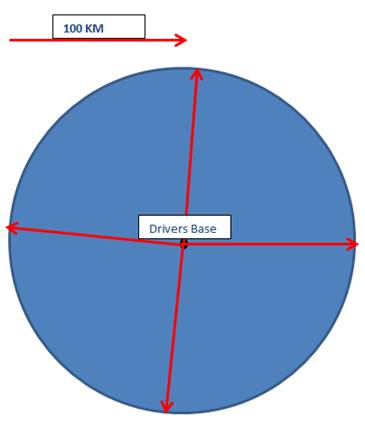
Drivers who travel up to 100km or less from their base do not have to use a Work Diary but are still required to record work and rest information and provide this to their record keeper.
A Distance Calculator to determine your 100km radius from base has been developed by the NTI.
Who is a record keeper?
A record keeper may be:
- the employer, if the driver is employed
- an accredited operator, if the driver is working under Basic Fatigue Management or Advanced Fatigue Management accreditation
- the driver (as a self-employed or owner driver).
What is a fatigue-regulated heavy vehicle?
A fatigue-regulated heavy vehicle is:
- a vehicle with a gross vehicle mass (GVM) over 12t
- a combination when the total of the GVM/gross combination mass (GCM) is over 12t
- buses with a GVM over 4.5t fitted to carry more than 12 adults (including the driver)
- a truck, or a combination including a truck, with a GVM of over 12t with a machine or implement attached.
What records do I need if I am doing local area work (up to 100km)?
Drivers operating under Standard Hours must keep a detailed written record of work and rest times in their own local area driving record. Drivers may record these details on a ‘daily run sheet’ or a similar document. Drivers can choose to use a National Driver Work Diary for local work if they wish to.
Note: Local area work is work relating to a journey where the driver will only drive within a 100km radius of their base. This refers to work classified as 100km work under the HVNL.
What information am I required to document if I’m not using a National Driver Work Diary for local work?
Drivers who are doing local area work (up to 100km) and who are not required to use the National Driver Work Diary must make local area records, which include:
- driver’s name and contact details
- driver’s current driver's licence number and the jurisdiction in which the licence was issued
- dates on which the driver drives a fatigue-regulated heavy vehicle
- Registration number for each fatigue-regulated heavy vehicle the driver drives
- the location of the driver’s base and dates of any changes
- total of the driver’s work times and rest times on each day on which the driver drives a fatigue-regulated heavy vehicle
- total of the driver’s work times and rest times for each week during which the driver drives a fatigue-regulated heavy vehicle.
What information is required to be recorded if I’m using a National Driver Work Diary?
For each driver, the record keeper must keep:
- the driver’s name, licence number and contact details
- the dates fatigue-regulated heavy vehicles were driven
- the registration number of the vehicle(s) driven
- the total of each driver’s work and rest times for each day and each week
- copies of duplicate work diary daily sheets (if applicable)
- driver’s rosters and trip schedules (including changeovers)
- driver timesheets and pay records
- any other information as required as a condition of an accreditation or exemption (such as driver training and health assessments).
All records must be:
- kept for three years after they are created
- kept at a location accessible to an authorised officer for audit or investigation purposes
- in a format that is readable, and reasonably assumed it will continue to be readable, in at least three years from the date of its creation.
- The location of a driver’s record is determined by the record keeper who notifies the driver; this is usually the driver’s base.
Do work and rest limits apply to me if I am using local area records?
Yes. Work and rest limits apply to local area work in a fatigue-regulated heavy vehicle.
Is there an easy-to-use document I can use to keep records?
Yes.
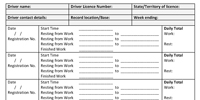
Local Area Record Template (DOCX, 27KB)
This template can be used to keep local area records.
Does this information apply to BFM and AFM drivers?
No. Drivers operating under BFM or AFM must use a National Driver Work Diary regardless of their distance from their base.
What is classified as a base?
Your base is the place where you normally work from. Each time you change base (even if you are only swapping between the same two bases) record the new base and the date at the time you change.
If you've completed all available lines on the Base, record location and accreditation number pages in your Work Diary, you can print the sheet below and keep it in your work diary.
How do I update my base details?
On pages 32 and 33 of the National Work Diary, you can update your base details.
What if I didn’t plan to travel more than 100km from my base, but I do?
If you undertake unplanned work over 100km under standard hours, you must start to record the required details for the day in your work diary as soon as possible.
You must fill in your daily sheet from the start of the day (i.e. midnight), not just from the time you became aware you would be undertaking work over 100km from your base location.
Do I need to round my times up and down when working locally and using a run sheet?
When working locally on a run sheet, rounding times up or down is not required. Rounding times only applies when using a Written Work Diary (WWD) or an Electronic Work Diary (EWD).
Can I use a work diary to record local area work even if I don’t need to?
Yes, you can. You are able to use the National Driver Work Diary or an Electronic Work Diary to record your local area work. It may also be part of your company policy to do so. The diaries are a sufficient way to record your local area work.